
As many automakers pull back on ambitious electric vehicle plans amid softer U.S. demand and the end of federal tax incentives, Toyota is charting a different course. In March 2026, the Japanese automaker announced a $1 billion investment across its Kentucky and Indiana plants, signaling long-term confidence in American manufacturing and a measured approach to electrification.
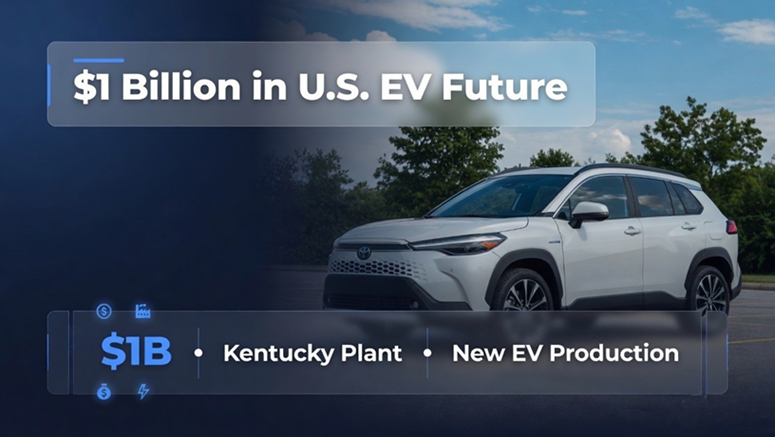
The move stands out in an industry marked by cancellations and delays. It reinforces Toyota’s multi-pathway strategy—blending strong hybrid sales with targeted EV expansion—while many rivals recalibrate after the September 2025 expiration of the $7,500 federal EV tax credit.
A Milestone Announcement Tied to 40 Years in Kentucky
Toyota made the announcement during celebrations marking the 40th anniversary of Toyota Motor Manufacturing Kentucky (TMMK) in Georgetown. The sprawling facility is Toyota’s largest vehicle manufacturing plant in the world and has produced more than 15 million vehicles since opening.
Of the total investment:
- $800 million goes to the Georgetown, Kentucky plant.
- $200 million supports expanded production of the popular Grand Highlander SUV at Toyota’s Indiana facilities.
The Kentucky allocation will prepare the plant for battery-electric vehicle (BEV) production and increase capacity for the Camry sedan and RAV4 crossover. This builds on Toyota’s November 2025 pledge of up to $10 billion in additional U.S. investments over five years. The first U.S.-made EV from Georgetown—a three-row battery-electric SUV, expected to be a version of the Highlander— is slated to begin production in fall 2026. The new funding positions the plant for its second U.S.-produced BEV as well.
Kentucky Governor Andy Beshear highlighted the partnership, noting Toyota’s role in creating good jobs and strengthening the local economy. The company also pledged additional support for workforce development in the state.
Toyota’s commitment comes at a time when the U.S. EV market faces significant headwinds. Recent data shows North American EV and plug-in hybrid sales dropping sharply—down around 25-28% year-over-year in recent months—following the loss of purchase incentives. Many automakers have responded by canceling or delaying EV programs.
For example, Nissan recently scrapped plans for two electric SUVs at its Canton, Mississippi plant, redirecting the facility toward gasoline trucks and hybrids. Broader reports indicate billions in previously announced EV and battery manufacturing investments have been canceled or scaled back since 2025.
In this environment, Toyota’s decision to invest hundreds of millions in U.S. EV production capacity stands out as a contrarian bet on the long-term future of electrification in America.
Toyota’s Pragmatic “Multi-Pathway” Approach
Unlike some competitors who bet heavily on a rapid all-EV transition, Toyota has consistently advocated for a diversified powertrain strategy. Hybrids remain a cornerstone of its U.S. success, offering immediate fuel savings without the need for charging infrastructure or range compromises.
The new investment aligns with this philosophy. By preparing Georgetown for additional BEV production while simultaneously boosting output of proven hybrid-friendly models like the Camry and RAV4, Toyota is hedging its bets. It can scale EVs as demand and infrastructure mature while continuing to serve customers who prefer or need hybrids today.
This approach may prove resilient. Recent consumer research, including JD Power’s 2026 Electric Vehicle Consideration Study, shows that while actual EV purchases have softened, interest is rebounding in some segments—partly driven by higher gasoline prices. Toyota’s hybrid strength gives it a buffer that pure-EV-focused rivals lack.
The Georgetown investment supports thousands of existing jobs and reinforces Kentucky’s position as a key hub in Toyota’s North American operations. Expanded production of popular models like the Camry, RAV4, and Grand Highlander should help meet strong demand for these vehicles.
For consumers, it signals that Toyota intends to bring more electric options to market from U.S. factories, potentially improving supply chain resilience and supporting “Made in America” considerations. The three-row EV SUV arriving in late 2026 could appeal to families seeking a practical electric alternative to gas-powered three-row vehicles.
However, challenges remain. U.S. EV adoption continues to face hurdles around upfront pricing, charging access, and consumer range expectations. Toyota will need to deliver competitive products at accessible price points to convert interest into sales.
Toyota’s $1 billion commitment is more than just another factory upgrade—it’s a statement. In an industry whipsawed by policy changes, shifting consumer preferences, and aggressive EV timelines that have proven difficult to sustain, Toyota is choosing measured, factory-backed progress over dramatic retreats or overpromises.
By investing in both its hybrid strengths and future EV capabilities on U.S. soil, Toyota positions itself to navigate the current slowdown while remaining ready for the next phase of electrification. As other automakers reassess their American EV strategies, Toyota’s Georgetown bet offers a pragmatic counter-narrative: steady investment in manufacturing capability, paired with a realistic view of what customers want today and tomorrow. The coming months will reveal how this investment translates into new models and production milestones. For now, it stands as one of the more confident moves in a cautious U.S. automotive landscape.
You like to Read – Tesla Fights EPA Rollback Even as Musk Backs Trump


