
In a stark reversal that underscores the turbulent state of America’s electric vehicle transition, Nissan has canceled long-planned electric vehicle production at its Canton, Mississippi assembly plant. The Japanese automaker informed dealers and suppliers in late April 2026 that it would not proceed with two battery-electric SUVs originally slated for the facility, scrapping a roughly $500 million investment.
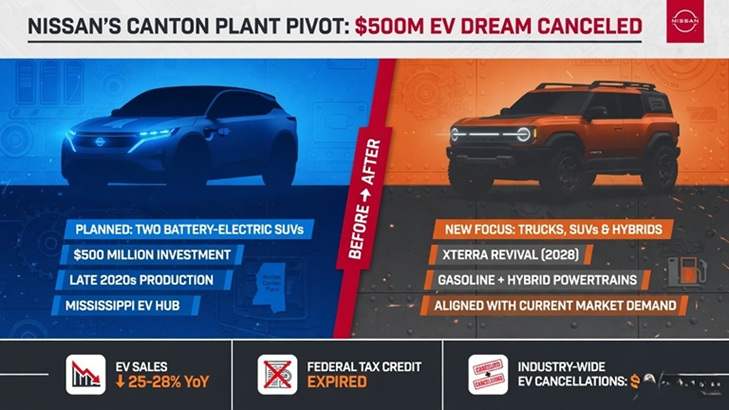
The decision comes as U.S. EV sales continue to struggle following the expiration of the federal $7,500 tax credit in September 2025. Instead of becoming a hub for zero-emission vehicles, the massive Canton plant will refocus on gasoline-powered trucks, SUVs, and hybrid models — starting with a revival of the body-on-frame Xterra expected in late 2028.
Nissan had positioned the Canton facility as a key part of its U.S. electrification strategy. The plant was set to produce two all-electric SUVs — one for the Nissan brand and another for Infiniti — with production originally eyed for the late 2020s. The $500 million commitment included retooling and new capabilities to support battery-electric vehicle manufacturing.
That vision is now off the table. Nissan stated the move aligns with “market conditions, customer demand, and Nissan’s updated strategic direction.” The Canton plant, one of Nissan’s largest U.S. facilities, will instead prioritize conventional powertrains and electrified options that better match current buyer preferences.
The shift includes bringing back the Xterra nameplate as a rugged, body-on-frame SUV — a segment where demand for capable trucks and off-road vehicles remains strong. This pivot reflects a broader recalibration at Nissan, which has already scaled back other EV efforts, including winding down the Ariya crossover in the U.S. market.
Why the Sudden Change?
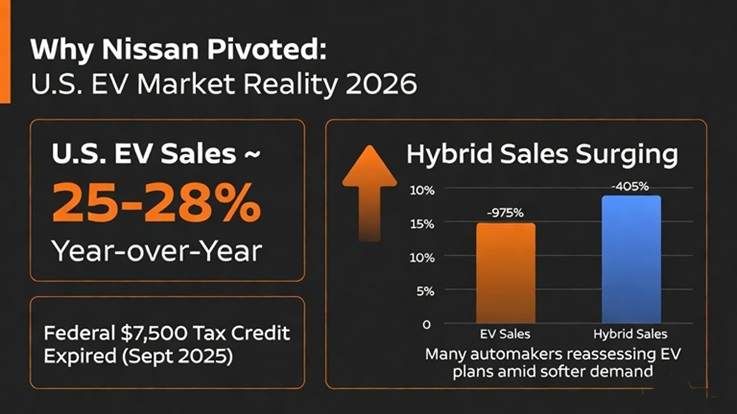
The timing is no coincidence. U.S. EV demand has softened significantly. Recent data shows North American EV and plug-in hybrid registrations dropping around 25–28% year-over-year in recent months, with overall EV market share hovering near 5% in early 2026. The loss of federal purchase incentives removed a major tailwind that had supported earlier growth.
At the same time, many buyers are gravitating toward hybrids, which deliver immediate fuel savings without the need for charging infrastructure or range compromises. Hybrid sales have surged in response to elevated gasoline prices, while pure battery-electric models face headwinds from higher upfront costs and lingering concerns about charging access and resale value.
Nissan’s move mirrors actions by other automakers who have delayed, downsized, or outright canceled EV programs in the U.S. Industry-wide, tens of billions in previously announced EV and battery manufacturing investments have been pulled back since 2025 as companies reassess demand and economics.
Nissan Canton Plant – Before vs After the Pivot
| Aspect | Original Plan (EV Focus) | New Direction (2026 Onward) | Key Change |
|---|---|---|---|
| Investment | ~$500 million | Canceled | Full reversal |
| Products | Two battery-electric SUVs (Nissan + Infiniti) | Body-on-frame Xterra + trucks & hybrids | Shift from BEV to ICE + Hybrid |
| Production Start | Late 2020s | Xterra targeted for late 2028 | Delayed & changed |
| Plant Focus | Electric vehicle manufacturing hub | Traditional trucks, SUVs & electrified vehicles | Major strategic pivot |
| Powertrain | 100% Battery Electric | Gasoline + Hybrid | Move away from pure EV |
| Strategic Driver | U.S. EV growth & federal incentives | Current market demand & affordability | Response to weak EV sales |
Impact on Mississippi and the Supply Chain
For Canton and the surrounding Mississippi region, the decision carries real consequences. The plant has long been a major employer, and the EV expansion was expected to bring additional jobs and investment. Shifting back to traditional truck and SUV production may preserve or even stabilize some roles, but it removes the promise of new high-tech EV-related positions and supplier opportunities.
Local economies tied to auto manufacturing often feel these pivots acutely. Parts suppliers who had begun preparing for EV components may now need to adjust, while the community loses out on the economic multiplier effect that large-scale EV investments were projected to deliver.
On the positive side, continued production of popular truck-based vehicles could provide more predictable volume and help sustain the plant’s long-term viability in a market that still heavily favors SUVs and pickups.
This Canton pivot signals a more pragmatic approach from Nissan in North America. Rather than chasing aggressive EV volume targets that have proven difficult to hit, the company appears focused on vehicles Americans are actually buying today — capable trucks, SUVs, and hybrids that offer strong value and proven reliability.
It also highlights the challenges facing legacy automakers trying to balance global electrification goals with regional market realities. While Nissan continues EV development elsewhere (including updates to models like the Leaf), its U.S. strategy now emphasizes flexibility across powertrains. For consumers, the change means fewer new Nissan and Infiniti electric options will be built domestically in the near term. Shoppers interested in affordable or rugged EVs from the brand may have to wait longer or look to imported or existing models.
Nissan’s decision in Mississippi is part of a wider recalibration across the U.S. auto industry. With EV sales down and hybrids rising, many companies are rethinking factory allocations and product timelines. At the same time, some automakers — including Toyota — continue investing in U.S. EV production capacity, showing that not everyone is retreating.
The Canton pivot serves as a reminder that the shift to electric vehicles is neither linear nor guaranteed on any fixed schedule. Policy changes, consumer preferences, infrastructure readiness, and economic conditions all play decisive roles.
For now, the Canton plant will keep building vehicles that align with strong current demand. Whether this represents a temporary adjustment or a longer-term strategic shift will depend on how quickly EV affordability improves, charging networks expand, and buyer confidence returns. As the U.S. auto landscape continues evolving in 2026, stories like Nissan’s Mississippi reversal offer a clear window into the real-world tensions shaping the future of American manufacturing and mobility.
You like to Read – Toyota Bucks the Industry’s EV Retreat with Bold $1 Billion U.S. Plant Investment


