
For years, a familiar critique has echoed through EV forums, policy debates, and auto media: plug-in hybrids are a half-measure that makes no sense. They’re heavier and more complex than regular hybrids. They cost more upfront than a standard gas model. And worst of all, critics insisted, most owners never bother plugging them in—turning an expensive, complicated vehicle into nothing more than a slightly thirstier hybrid with dead weight in the trunk. It was a tidy narrative. It also turns out to be largely wrong for real American drivers.
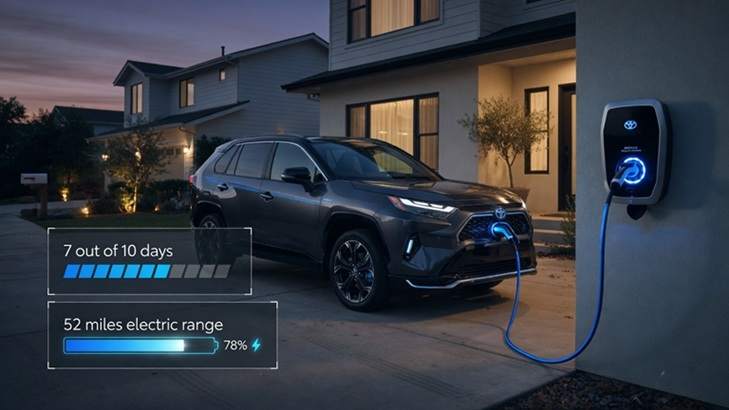
New data from Toyota Research Institute North America (TRINA) quietly dismantles the central myth. Researchers analyzed anonymized driving and charging data from more than 6,000 plug-in hybrids across the U.S. and Canada—primarily 2021–2024 Toyota RAV4 PHEVs (then called RAV4 Prime) and Lexus NX 450h+ models. The findings, published in a peer-reviewed SAE white paper, show that Toyota PHEV owners plug in on seven out of every ten driving days on average. Only 9% rarely or never charge. Lexus PHEV owners were even more diligent, charging eight or nine days out of ten, with just 4% rarely plugging in. These aren’t lab conditions or optimistic surveys. This is real-world behavior from thousands of North American vehicles over multiple years.
The “owners won’t plug them in” argument always rested on a shaky assumption: that charging would feel like too much hassle for the average person. Toyota’s data shows the opposite for most buyers. With electric ranges in the study vehicles around 37–42 miles—already enough to cover a large share of daily American driving without ever starting the gas engine—owners had every incentive to plug in when it was convenient.
And convenient it often is. A huge portion of U.S. households have access to home charging, whether a standard outlet in a garage or a dedicated Level 2 charger. For suburban and rural drivers—the exact people buying RAV4-sized crossovers—this removes the public-charging anxiety that still slows full EV adoption in many regions.
The economics help too. At average U.S. residential electricity rates around 18 cents per kWh, driving those first 40 miles on electrons is dramatically cheaper than gasoline for most owners. The study noted that only in small pockets where gas is unusually cheap relative to electricity does the incentive flip.
Regional differences exist, as expected in a country this large. But the overall pattern is clear: when the vehicle offers usable electric range and home charging is accessible, the majority of owners use it. The “PHEV owners just drive them like regular hybrids” line was always more assumption than evidence. Now there’s hard data against it.
Toyota didn’t stop at proving yesterday’s PHEVs worked better than critics claimed. The all-new 2026 RAV4 Plug-in Hybrid raises the bar further. Manufacturer estimates put all-electric range at around 52 miles—roughly 10 miles more than the previous generation—while total system output climbs to 324 horsepower. All-wheel drive is standard.
Pricing is aggressive too. The entry SE trim starts at $41,500, with higher trims like the XSE and new Woodland and GR Sport variants filling out the lineup. Some grades now support DC fast charging via CCS, something rare in PHEVs, and onboard AC charging speeds have improved significantly (up to 11 kW on certain trims). A full charge from a capable home setup can happen in a few hours overnight.
For context, the average American driver covers roughly 35–42 miles per day depending on the dataset (commutes plus errands). A 52-mile electric range means millions of RAV4 PHEV owners can handle the vast majority of their annual miles on electricity alone, then switch seamlessly to hybrid mode for longer road trips, heavy loads, or weeks when they forget to plug in. It’s the flexibility American buyers have quietly wanted: electric for daily life, gas capability when life gets complicated.
The Prius Plug-in Hybrid received similar updates, with up to 44 miles of electric range and strong efficiency ratings when the battery is depleted.
This isn’t just good news for Toyota loyalists. It validates a pragmatic middle path that many American families actually want right now. Full EVs still face real hurdles for large segments of the market: higher upfront cost for equivalent capability, charging access outside dense metro areas, and the psychological weight of managing range on family road trips or in extreme weather. PHEVs sidestep most of those frictions while delivering immediate tailpipe-emission reductions on the miles that matter most—the short, repeatable daily ones.
For policymakers focused on rapid decarbonization, the data suggests PHEVs deserve more credit as a bridge technology that works today with existing home electrical infrastructure. They don’t require every driver to install a 240-volt charger or wait for a robust public fast-charging network to reach every small town and highway corridor. They also don’t force buyers into larger, more expensive batteries than many actually need for their lifestyle.
Toyota’s broader strategy—investing heavily in hybrids and PHEVs alongside its EV efforts—looks less like stubbornness and more like reading the room. U.S. buyers have made the RAV4 one of the best-selling vehicles in the country for years. Offering a plug-in version that real owners actually use as intended expands that success while cutting emissions faster than waiting for perfect EV conditions.
Critics were right about one thing: PHEVs only deliver their full environmental and cost benefits if owners plug them in. Toyota just showed that, for the overwhelming majority of its North American PHEV customers, they do exactly that.
The old “they don’t make sense” argument is starting to look like yesterday’s talking point. The new reality is more interesting: a practical, popular vehicle that gives drivers electric driving for most of their miles without asking them to change how they live or travel. For a country still deeply attached to crossovers, road trips, and the freedom to not plan every mile around a charger, that combination suddenly makes a whole lot of sense.
Toyota didn’t just defend PHEVs with this study. It showed why millions of practical American drivers might choose one—and keep choosing to plug it in.
Related Post


