
It happened quietly, the way big shifts often do. In April 2026 — the first full month of a fresh global energy crisis triggered by conflict in the Middle East — the world’s wind turbines and solar panels together produced more electricity than every natural gas plant on the planet.
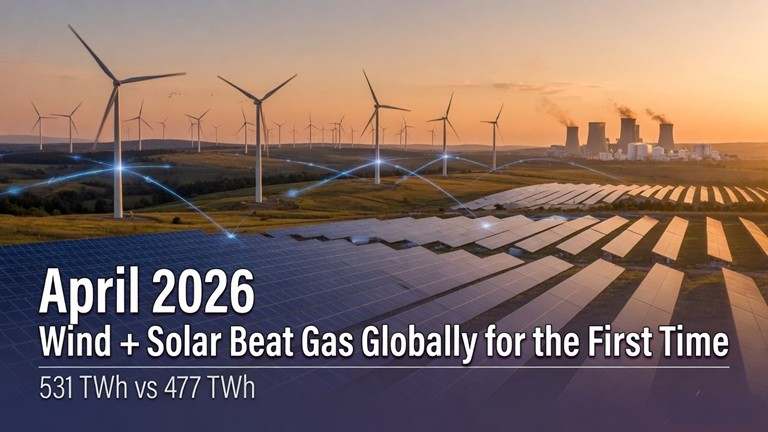
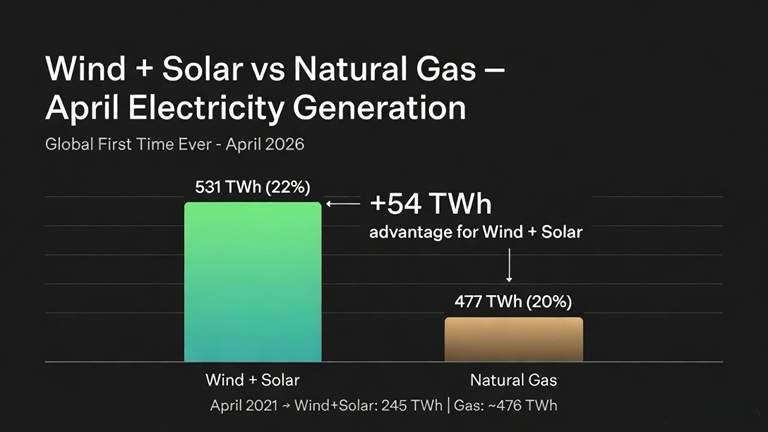
According to fresh analysis from energy think tank Ember, wind and solar delivered a record 531 terawatt-hours that month. Gas-fired plants managed 477 TWh. That 54 TWh gap is roughly the monthly electricity consumption of a major industrial economy. Wind and solar captured 22% of global generation; gas slipped to 20%. It was the first time this crossover had ever occurred for an entire month.
Five years earlier, in April 2021, the picture looked almost reversed: gas produced nearly double what wind and solar combined could manage.
This wasn’t a fluke of unusually sunny or windy weather cherry-picked for headlines. April tends to be the month when the milestone becomes mathematically likeliest — spring in the Northern Hemisphere brings strong wind output alongside rapidly rising solar generation, while electricity demand sits in the seasonal lull between winter heating and summer air conditioning. But the underlying trend is what matters: wind and solar are no longer niche supplements. They are now the primary force meeting new global electricity demand.
Global wind and solar output jumped 13% year-over-year in April 2026. China led with +14%, the EU posted +13%, the UK surged +35%, Australia +17%, and even the United States delivered a solid +8%. The growth was enough to cover most of the increase in worldwide electricity demand, which kept gas generation from rising much at all. There was no widespread scramble to burn more coal as a backup.
Ember analyst Kostantsa Rangelova put it plainly: the current energy crisis has only strengthened the economic case for renewables over imported gas, while adding political urgency for countries to reduce exposure to volatile fossil fuel markets.
That last part is the story most coverage has missed.
Why this matters to American readers right now
The United States is the world’s top LNG exporter. We have built a powerful industry around shipping American natural gas to Europe and Asia. Yet the countries on the receiving end are racing to build domestic wind, solar, and storage precisely so they never have to rely on imported gas during the next crisis. April’s milestone shows they are succeeding faster than almost anyone modeled.
For the US domestic picture, the implications are equally sharp. Wind and solar already produce more electricity in America than coal does. In 2025 they reached roughly 19% of US generation. New data shows nearly all net new US power capacity coming online in 2026 will be solar, wind, and batteries. The Inflation Reduction Act’s manufacturing incentives have sparked real factory construction in Georgia, Texas, Ohio, and the Midwest — jobs making panels, inverters, and battery systems that didn’t exist at scale five years ago.
At the same time, surging electricity demand from data centers, AI, and EV charging is forcing a reckoning. Hyperscalers and manufacturers want power that is both cheap and reliable 24/7. Gas can provide the reliability piece, but it is no longer the cheapest option in most places — especially once you factor in price volatility. The winning formula increasingly looks like renewables plus storage (think large-scale batteries that can shift midday solar into evening peaks) plus smarter transmission.
Here’s the angle that hasn’t been widely discussed: this global first is not primarily a climate story. It is an energy security and industrial competitiveness story.
Countries that treat renewables as a luxury add-on will find themselves paying more for imported gas during every future shock. Countries (and companies) that treat wind, solar, and storage as core infrastructure will have cheaper, more resilient power — and the supply chains and jobs that come with building it.
The United States has the resources, the capital, and the innovation edge to lead this transition. We also have legacy energy regions whose workers and communities deserve a deliberate path forward rather than abrupt disruption. The April milestone doesn’t mean gas disappears overnight — it still has critical roles in industry, heating, and flexible power. But its share of the electricity mix is peaking earlier than most forecasts assumed, especially outside the US.
The next symbolic thresholds will come quickly: when wind and solar beat gas on an annual basis globally (likely within a few years), and when they consistently outproduce all fossil fuels combined. Each one will arrive with less fanfare than it deserves, because the momentum is already baked into factories being built today and electrons flowing tomorrow.
For American families watching utility bills, for manufacturers deciding where to locate new plants, for EV drivers wondering whether the grid can handle millions more cars, and for workers in both traditional and emerging energy sectors — the signal from April 2026 is clear. The future grid is being built right now. The only question is whether the United States decides to lead it at full speed or play catch-up later.
Related Post


