
Dominion Energy is taking the Trump administration to court after the U.S. Department of the Interior (DOI) ordered five offshore wind projects to halt offshore work on December 22 — including Dominion’s 2.6-gigawatt Coastal Virginia Offshore Wind (CVOW), the largest offshore wind farm in the United States.
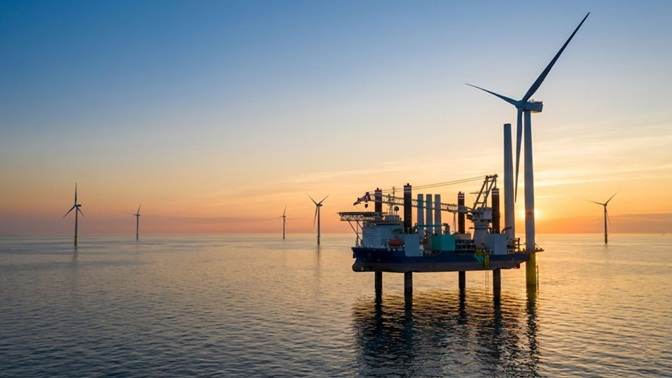
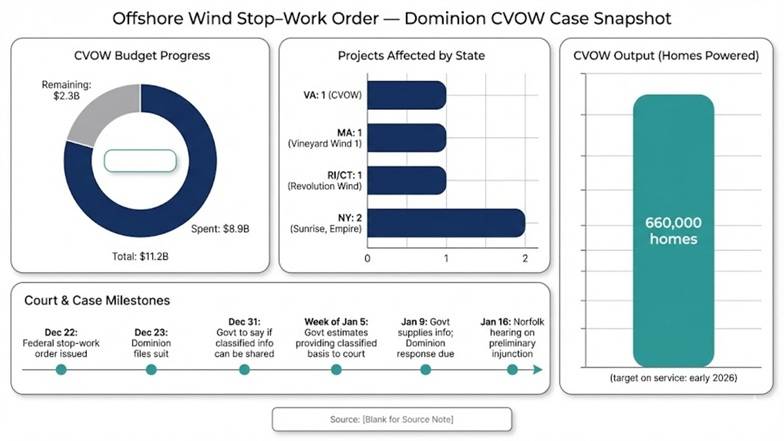
CVOW has been under construction since early 2024 and was slated to start delivering power in early 2026 — enough clean electricity for about 660,000 homes. Dominion says it has already spent roughly $8.9 billion of the project’s $11.2 billion budget, costs ultimately borne by customers. With Virginia in the middle of a data-center boom, the timing stings.
CVOW is a cornerstone project for Virginia’s future grid — especially as data centers expand. Prolonged delays risk higher costs, tighter power supplies, and missed climate goals. These sites depend on narrow weather windows and rare specialized ships. Every idle day is expensive, and rescheduling is not as simple as flipping a switch. A broad stop-work order this late in construction is uncommon. The outcome here will ripple across the entire U.S. offshore wind pipeline.
National security concern, The administration points to “classified” analyses that offshore wind turbines create radar interference (so‑called “clutter”), potentially masking real targets or generating false ones. Radar effects from turbines are not new; developers typically coordinate siting and mitigation with federal agencies and the military. Dominion says CVOW was planned with those stakeholders.
The utility calls the order “arbitrary and capricious” and unconstitutional, arguing it provides no public evidence and forces vessels and crews to sit idle while costs mount. Dominion says unexpected downtime drives up project costs and risks timelines, which can cascade into rate impacts for customers.
| Project | Location | Status before order | Noted details |
|---|---|---|---|
| Coastal Virginia Offshore Wind (CVOW) | Virginia | Under construction since early 2024 | 2.6 GW; ~$8.9B spent of $11.2B; early 2026 target in-service |
| Vineyard Wind 1 | Massachusetts | Under construction | Offshore work paused |
| Revolution Wind | Rhode Island & Connecticut | Under construction | Offshore work paused |
| Sunrise Wind | New York | Under construction | Offshore work paused |
| Empire Wind | New York | Under construction | Offshore work paused |
Where the lawsuit stands (nuts-and-bolts timeline)
- Dec 22: DOI issues offshore stop-work order for five wind projects.
- Dec 23: Dominion files suit and requests a temporary restraining order (TRO).
- Court action: U.S. District Judge Jamar Walker converts the TRO request into a motion for a preliminary injunction, which could allow work to resume while the case proceeds.
- Dec 31: Judge directs the government to say whether it will share the classified materials with Dominion’s representatives.
- Week of Jan 5: Government estimates it can provide the classified basis to the court (per reporting by Maritime Executive).
- Jan 9: Government to supply information to the court; Dominion to file its response.
- Jan 16: Hearing in Norfolk on the preliminary injunction motion.
The administration has repeatedly signaled skepticism of offshore wind. A sudden, across‑the‑board halt, justified by references to classified reports, fits that stance. Developers contend any new radar issues should be addressed transparently with mitigation steps — not an emergency brake on five active sites — especially when projects were sited in coordination with federal stakeholders.
Idle vessels, rebooking specialized equipment, and slipping construction windows can add real money. If timelines push, financing and carrying costs rise too. With major load growth from data centers and electrification, delaying large clean power projects tightens the margin for error — especially in peak seasons. Pauses ripple through Gulf Coast shipyards, East Coast ports, steel fabricators, and union crews trained for offshore work.
A credible, specific national security justification and a path to mitigation. Courts typically give leeway on security matters — but not without a record. Concrete evidence of harm from delays and proof that prior siting/mitigation steps addressed radar concerns — or can be updated quickly.
The judge’s call on the preliminary injunction, If granted, offshore work could resume while the legal fight continues. Whether (and how) classified analyses are shared with Dominion’s cleared representatives will shape the evidentiary record. A practical mitigation roadmap (radar filters, operational constraints, refined layouts) could allow construction to proceed while security issues are addressed.
A week before Christmas, a sweeping stop-work order hit five offshore wind farms — including the nation’s largest. Dominion sued the next day. The court has already fast‑tracked the case and asked the government to show its cards. If the administration can’t substantiate an urgent national security risk, expect pressure to pivot from “stop” to “solve,” so crews can get back on the water and Virginia can keep its clean‑power buildout on schedule.
Sources: Company statements, court filings, and reporting referenced in the case docket (including Maritime Executive). Dates and figures reflect filings and developer disclosures as described above.
Related Post


