
A new analysis from energy think tank Ember says electric vehicles are doing more than lowering emissions — they’re starting to reduce one of the world economy’s biggest headaches: oil dependence.
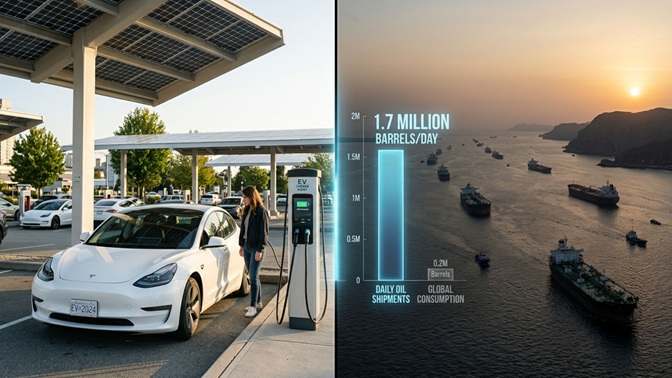
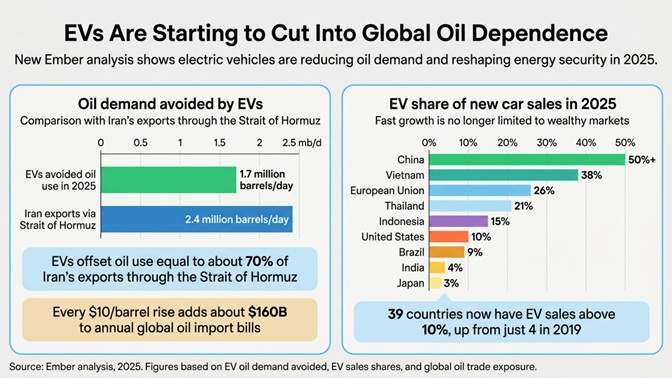
For decades, oil has been the pressure point of the global economy. When supply gets tight or conflict breaks out near major shipping routes, prices can spike fast — and drivers, businesses, and governments all feel the pain. Now, electric vehicles are beginning to chip away at that risk. A new report from Ember finds that the world’s growing EV fleet avoided 1.7 million barrels of oil consumption per day in 2025. That’s a big number on its own, but the comparison that really grabs attention is this: it is getting close to 70% of Iran’s oil exports through the Strait of Hormuz, one of the most sensitive energy chokepoints on the planet.
EVs are starting to take a meaningful bite out of global oil demand. Daan Walter, a principal at Ember, put it bluntly: “Oil is the Achilles’ heel of the global economy.” He said the latest geopolitical tensions have highlighted just how exposed many countries — especially in Asia — still are.
Oil may be produced in some places, but its price is set in a global market. That means nobody really gets a free pass when prices jump. Ember says about 79% of the world’s population lives in countries that import oil. And when oil gets more expensive, the bill rises quickly. The group estimates that every $10 increase per barrel adds around $160 billion to global oil import costs each year.
That’s not just a number for economists to debate. It can show up as:
- higher gas prices at the pump,
- more expensive airline tickets,
- rising shipping costs,
- and broader inflation for everyday goods.
The Strait of Hormuz is a major reason this matters so much. The narrow waterway handles about one-fifth of global oil exports, while the wider Gulf region supplies roughly 29% of the world’s oil. If tensions flare there, global energy markets can get rattled in a hurry. Asia is especially exposed. Ember says the region imports around 40% of its oil through the Strait of Hormuz, making it particularly vulnerable to supply shocks.
And even places that produce oil are not immune. Since the latest conflict began, gasoline prices in Texas — one of America’s biggest oil-producing regions — have climbed by more than 25%, rising above prices in oil-importing countries like the UK and France. That’s a reminder that when oil markets get shaky, the ripple effects reach everyone.
EVs are offering a way out
This is where electric vehicles come in. Unlike gasoline and diesel cars, EVs don’t rely on imported crude to keep moving. As more drivers switch to electric, countries can reduce how much oil they need to buy from abroad. Ember argues that transport electrification is one of the fastest ways to cut that exposure. The think tank estimates that replacing imported oil used in transportation with EVs could cut global fossil fuel imports by about one-third and save roughly $600 billion per year
That’s a huge potential shift — not just for climate policy, but for economic security. The technology is no longer some far-off promise, either. Ember says electrification solutions already exist for more than three-quarters of global energy demand, and every country has enough domestic renewable resources to support that shift with wind and solar power. That matters because EVs work best as part of a bigger energy transition. If a country can power transport with electricity generated at home, it becomes less vulnerable to the kind of oil shock that can send prices soaring overnight.
EV growth is speeding up worldwide
One of the biggest takeaways from Ember’s analysis is that the EV transition is no longer limited to rich countries. In 2025, 39 countries recorded EV sales shares above 10%, up sharply from just four countries in 2019. That’s a sign the market is broadening fast.
| Country/Region | EV share of new car sales in 2025 | Notable takeaway |
|---|---|---|
| China | 50%+ | First time EVs passed half of new car sales |
| European Union | 26% | Strong adoption across major markets |
| Vietnam | 38% | Ahead of the EU in sales share |
| Thailand | 21% | Outpacing the U.S. |
| Indonesia | 15% | Also ahead of the U.S. |
| United States | 10% | Growing, but trailing several emerging markets |
| Brazil | 9% | Ahead of Japan |
| India | 4% | Also ahead of Japan |
| Japan | 3% | Lagging behind peers |
That table tells a bigger story: the EV boom is increasingly global. Countries in Southeast Asia and Latin America are moving faster than many people expected, and China has already crossed a major milestone by pushing EVs past half of all new car sales.
This is not just about what could happen someday. The savings are already starting to show up. At an oil price of $80 per barrel, Ember estimates:
- China saves more than $28 billion per year in avoided oil imports because of its EV fleet
- Europe saves about $8 billion per year
- India saves around $600 million annually
Those are meaningful numbers, especially for economies trying to reduce inflation pressures and strengthen energy security.
The International Energy Agency expects global oil demand to peak by 2029, and possibly earlier if EV adoption keeps accelerating. That means the role of EVs is changing. They are still a climate story, of course. But they are also becoming a pocketbook story, a trade story, and a national security story. every electric car on the road is one less vehicle tied directly to oil market chaos. And in a world where one shipping lane or one geopolitical flare-up can rattle the whole economy, that’s starting to look like a pretty big deal.
Related Post
Tesla Q4: $24.8B Rev, $0.45 EPS—Key Risks and Upside
2026 Mitsubishi Triton — new design, powertrain, interior, specs, and release date
2026 Ford Sierra Cosworth — new design, powertrain, interior, specs and release date


