
Kelley Blue Book’s early read on November shows a mixed bag for electric vehicles: prices eased, incentives jumped, and yet sales hit the brakes. The U.S. EV market is clearly recalibrating as shoppers weigh deals, charging realities, and a flood of new metal.
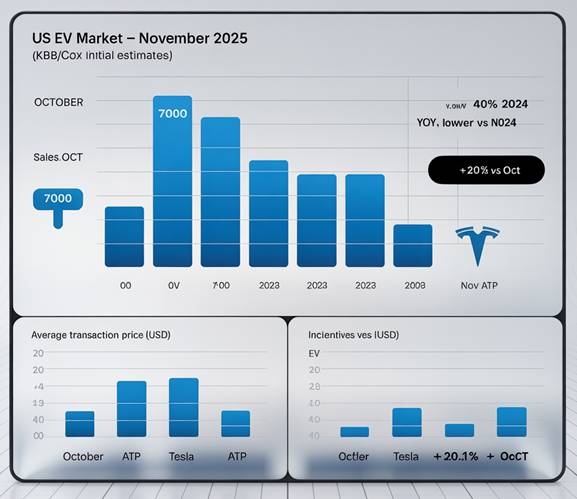
Just over 70,000 units in November — more than 40% below a year ago and about 5% under October. EV average transaction price (ATP) was $58,638, down 0.8% from October, but still up 3.7% year-over-year. Discounts averaged 13.3% of ATP — lower than last November, but up 20.1% from October. Company sales declined for a second straight month, down 22.7% year-over-year, with Model 3 demand taking the biggest hit.
November snapshot
| Metric | November 2025 | Change vs. Nov 2024 | Change vs. Oct 2025 |
|---|---|---|---|
| U.S. EV sales (units) | Just over 70,000 | Down 40%+ | Down ~5% |
| EV ATP (average transaction price) | $58,638 | +3.7% | -0.8% |
| Average incentives | 13.3% of ATP | Lower YoY | +20.1% |
| Tesla ATP | $54,310 | -1.7% | +1.5% |
| Tesla sales | — | -22.7% | Down (second straight month) |
| Model 3 sales | — | -42.1% | -11.9% |
| Model Y ATP | — | +0.9% | +0.9% |
| Model Y sales | — | -0.5% | +2.5% |
| Cybertruck sales | 1,194 | — | Lowest month of 2025 |
| Cybertruck ATP | $94,254 | Higher | Higher |
Model 3 Sales dropped 42.1% vs. November 2024 and 11.9% vs. October. That’s the bulk of Tesla’s year-over-year decline. Model Y Still America’s best-selling EV. Prices rose 0.9% from a year ago and vs. October. Sales ticked up 2.5% month-over-month, though they were 0.5% lower than last November. After a hot start in the six-figure segment, Cybertruck sales slipped to 1,194 units — the lowest monthly total of 2025 so far — while its average price climbed to $94,254.
It’s important to remember that the KBB ATP is a measure of what is bought, not what is available,” said Cox Automotive executive analyst Erin Keating. Nearly half of new-vehicle buyers are over 55 and in peak earning years — folks who tend to favor high-end SUVs over entry-level EVs. In November, vehicles over $75,000 moved more volume than those under $30,000. Several brands are between model years or tweaking trims and pricing, which can pause shopper momentum. Charging concerns in some regions, high interest rates compared to pre-2022 norms, and shoppers waiting for year-end or new-year incentives all play a role.
This is a more negotiable EV market than earlier in 2025. Incentives are up, prices are softening in spots, and inventory is improving in many regions. Translation: If you’re EV-curious, it’s a good time to cross-shop and ask for an out-the-door quote. The push now is smarter pricing, better trims, and clearer messaging. Consumers want simple charging, transparent range, and features that fit everyday life — at the right payment.
With average incentives at 13.3% of ATP, your real-world deal can be meaningfully lower than the sticker. If the EV you want is pricey, compare similarly sized hybrids or PHEVs — or look at competing EVs with stronger discounts. Ask about home charger installation credits, public charging partnerships, and software that preconditions the battery for faster road-trip charging. Eligibility for federal and state programs can change with model year, trim, and battery sourcing. Have the dealer show you the latest documentation.
Model Y continues to be the volume anchor, suggesting family-sized crossovers remain the safe bet in EV land. Model 3’s drop shows how sensitive the market is to fresh rivals, price perception, and incentives. With more buyers shopping above $75,000 than under $30,000 in November, ATPs may stay elevated even as discounts rise — simply because of what’s being purchased.
November’s EV picture is a tale of two trends: better deals and slower sales. Prices inched down, incentives jumped, but shoppers still tapped the brakes. As the market searches for a new normal, the best move is to shop smart: compare trims, watch incentives, and make the charging plan part of your decision. If December brings steadier demand — and a few more juicy deals — 2026 could open with a more balanced EV market.
Related Post


