
A new World Energy Outlook says electricity demand, minerals, and geopolitics are reshaping the stakes for economies and households alike. The International Energy Agency (IEA) says the energy transition just hit fast‑forward. In its World Energy Outlook 2025, the agency argues that renewables, electrification, and artificial intelligence are now the main engines of growth across the energy system—and the clock is ticking on grids, minerals, and resilience. Energy security risks no longer stop at oil and gas; critical minerals vital for clean tech, defense, and AI have become fresh fault lines in global supply chains.
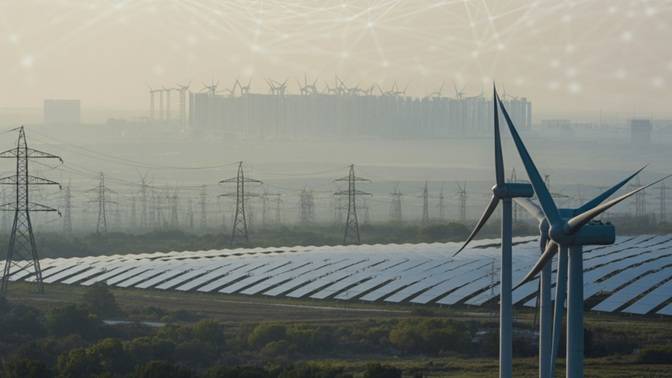
Fatih Birol, the IEA’s executive director, put it bluntly: “Last year, we said the world was moving quickly into the Age of Electricity – and it’s clear today that it has already arrived.”
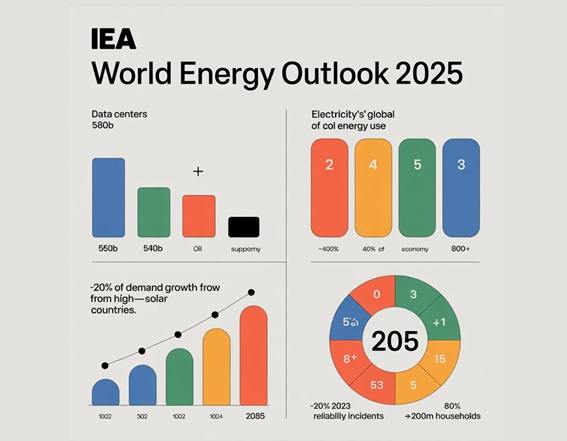
| Metric (IEA WEO 2025) | What it means |
|---|---|
| Electricity share today | ~20% of global energy use powers >40% of the economy |
| Data centers (2025) | ~580Bininvestment,vs. 580Bininvestment,vs. 540B for oil supply |
| Power gen vs. grid spend since 2015 | Generation investment up ≈70%; T&D up less than half that pace |
| Nuclear capacity outlook | At least +33% by 2035 (global) |
| Source of demand growth | By 2035, ~80% of growth from high‑solar countries |
| Energy access gap | ~730M people without electricity; nearly 2B using polluting cooking |
| Reliability stress (2023) | >200M households hit by infrastructure failures; ~85% tied to transmission lines |
A more complex, electrified future
The IEA outlines three scenarios—not predictions—that map what could happen based on policy, technology, and investment choices. Across every path, electricity is the main act. Think EVs and heat pumps, smarter factories, and an AI boom that never sleeps. Put simply: more of what we do—and how we grow—runs on electrons.
In plain English: the Age of Electricity isn’t on the horizon; it’s the neighborhood you’re already driving through. That’s great for efficiency and innovation, but it pushes a lot of pressure onto grids and the materials that make clean tech work.
Energy markets that were once China‑centric are getting a remix. Emerging economies—led by India and Southeast Asia—are setting the pace for power, mobility, and industrial energy demand. By 2035, roughly 80% of global energy consumption growth will come from countries rich in sunshine, which tilts the field toward solar.
Here’s the snag: wires and storage aren’t keeping up. Since 2015, investment in power generation has jumped nearly 70%, while transmission and distribution spending has climbed at less than half that rate. That mismatch risks future bottlenecks. The IEA’s message to governments is clear—fast‑track grid upgrades, streamline permitting, and coordinate across regions so clean power can actually reach homes and businesses.
Renewables and nuclear rise together
Solar leads across all IEA scenarios, while wind continues to scale—especially where grid access and permitting are improving. Nuclear is back in the conversation too: after years of stagnation, global capacity is set to increase by at least a third by 2035, thanks to both large plants and small modular reactors.
Dave Jones, chief analyst at Ember, summed up the momentum: “The world is moving in the right direction, and continued acceleration can drive a more rapid transformation of the energy system. Renewables and electrification will dominate the future – and fossil-importing nations will gain the most by embracing them.”
Energy security -minerals, AI, and geopolitics
Energy security is no longer just about oil shocks or gas pipelines. The IEA warns that critical minerals—lithium, nickel, cobalt, copper, rare earths—now underpin everything from batteries and wind turbines to defense hardware and AI compute. Supply risks can emerge anywhere along the chain: mines, refineries, or export chokepoints. Add in cyber threats to grids and the data centers that feed AI, and the security brief gets a lot broader.
As Birol noted, “there is no other time when energy security tensions have applied to so many fuels and technologies at once.” That means policy responses must balance affordability, access, competitiveness, and climate—at the same time.
Progress isn’t even. Roughly 730 million people still lack electricity, and nearly 2 billion rely on polluting cooking methods. Even in the IEA’s most ambitious pathways, the world overshoots 1.5°C this century before potentially dipping back below later on. Meanwhile, climate impacts are already tripping up energy systems: in 2023 alone, infrastructure failures affected more than 200 million households globally, with about 85% tied to transmission lines. Resilience isn’t optional anymore; it’s table stakes.
EVs, heat pumps, induction cooking, and smart appliances. grid upgrades and time‑of‑use rates will shape bills and reliability. data center growth and AI workloads demand clean power contracts (PPAs), on‑site solar/storage, and cyber‑resilience. accelerate interconnections, storage, flexible demand, and domestic mineral supply chains/refining. look at grids, storage, efficiency tech, and mineral processing—where bottlenecks meet policy tailwinds.
The IEA’s message is both optimistic and urgent: the energy transition is real, it’s moving faster than expected, and the center of gravity has shifted to electricity. The winners will be the places that build grids as quickly as they build generation, secure mineral supply chains, harden systems against climate and cyber shocks, and keep affordability front and center. The Age of Electricity has arrived—now it’s about making it resilient, fair, and ready for prime time.
Related Post


