
America just banked its biggest quarter ever for battery storage. In Q2 2025, 5.6 gigawatts (GW) of new capacity came online, according to the latest U.S. Energy Storage Monitor from the American Clean Power Association (ACP) and Wood Mackenzie. That’s a serious shot in the arm for grid reliability—and a potential break on power prices—right as electricity demand keeps climbing. What’s behind the surge? Utility-scale projects did the heavy lifting, residential batteries are booming, and even community and commercial systems are inching forward.
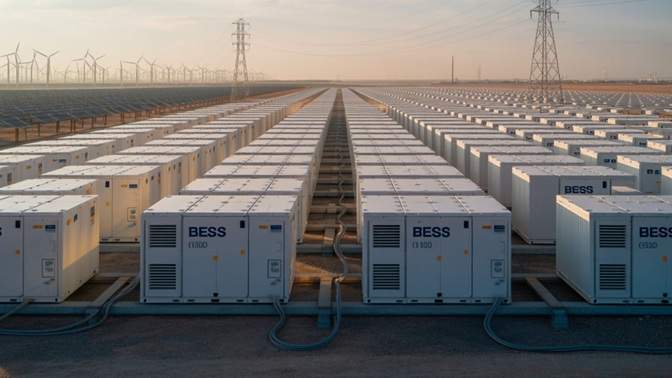
- 5.6 GW installed in a single quarter.
- Utility-scale alone added 4.9 GW—enough to cover the peak demand of roughly 3.7 million homes.
- Texas, California, and Arizona each put more than 1 GW on the board.
- The Southwest Power Pool (SPP) saw its first new battery projects in three years, with three installs in Oklahoma; Florida and Georgia are now expected to deploy more storage than previously forecast after fresh utility procurements.
Q2 2025 U.S. Battery Storage at a Glance
| Segment | New Capacity (Q2 2025) | Growth vs. Q2 2024 | Standout States |
|---|---|---|---|
| Utility-scale | 4.9 GW | — | TX, CA, AZ (each >1 GW) |
| Residential | 608 MW | +132% | CA, AZ, IL |
| Community/Commercial/Industrial (CCI) | 38 MW | +11% | CA, NY (70%+ of CCI), IL rising |
Utility-scale storage leads the way
Large battery plants are increasingly the grid’s “first responder” during hot evenings and cold snaps. They soak up cheap power when the sun is shining or wind is strong, then kick it back out when demand—and prices—jump. That’s why states with rapid load growth (hello, Texas) and high solar penetration (looking at you, California and Arizona) are leaning in.
“Energy storage is being quickly deployed to strengthen our grid as demand for power surges and is helping to drive down energy prices for American families and businesses,” said Noah Roberts, ACP’s vice president of energy storage. He also noted that, despite policy uncertainty, U.S. factories are on track to produce enough grid batteries to meet 100% of domestic demand.
Home batteries are having a moment
The residential market added 608 MW in Q2—up 132% year-over-year and 8% from Q1. The hot spots: California, Arizona, and Illinois. What’s driving it?
- Pairing with rooftop solar to keep the lights on after sunset.
- Higher-capacity home systems that can power more loads.
- Incentives and rate structures that reward storing cheap power and using it later.
Community, commercial, and industrial storage rose by 38 MW, up 11% year-over-year. California and New York accounted for more than 70% of the action, with Illinois gaining ground. The speed bumps: higher upfront costs and patchy policy support, especially for community-scale projects.
ACP/Wood Mackenzie project the U.S. will reach 87.8 GW of installed storage by 2029, with utility-scale and residential leading. But there are headwinds: New federal requirements tied to “Foreign Entities of Concern” (FEOC) complicate where battery cells and components can come from. The report expects a roughly 10% dip that year as new sourcing rules filter through project pipelines. Allison Weis, Wood Mackenzie’s global head of storage, said what she called Trump’s “big bill act” preserved the ITC for standalone batteries, but stricter sourcing rules after 2025 could trim the five‑year outlook by 16.5 GW. While domestic supply is ramping, shortfalls are possible, and some developers may still need Chinese cells to bridge gaps.
Projects that don’t hit key milestones by the end of 2025 could face new permitting and regulatory risks. Translation: developers have a strong incentive to get shovels in the ground now, under today’s clearer rules. Batteries help prevent blackouts by filling evening “duck curve” gaps and responding to sudden grid hiccups in milliseconds. By shaving peak demand, storage can reduce the need for pricey peaker plants and blunt price spikes. More batteries mean more room for wind and solar—without sacrificing reliability.
Q2 2025 was a watershed for energy storage. Big batteries are increasingly the backbone of a modern grid—keeping power reliable, prices in check, and the door wide open for more clean energy. If domestic supply rises on schedule and policy clarity holds, the runway to 2029 looks long—and busy.
Related Post


